







Tratamientos Brackets

Brackets

Correct the position of your teeth to have a beautiful smile and improve your bite.

From 1.790 €

From 1.790 €

What is it

What are brackets?

Updated May 12, 2026

Brackets are a key element in certain orthodontic appliances used to align the patient's teeth. Technically, the term 'bracket' refers to each piece that is glued to the front or back of the teeth and connected by a metal wire. They are usually made of metal, although there are also brackets of other materials, such as ceramic, sapphire crystal or resin, and they are adjusted to the surface of the teeth.

Their objective is to correct or eliminate certain defects related to the patient's bite or smile alignment, such as crowded teeth, open bite, crossbite, spaces between teeth (diastemas) or overbite, among others. Their components are three: brackets, ligatures and metal wire. The metal wire is the active part of the appliance, the one that actually exerts the force needed to push the teeth into the position they should occupy.

Types of brackets

There are various bracket options, classified by the materials with which they are made. Each material has its own characteristics and is ideal for a different patient profile.

Los brackets metálicos
Brackets autoligables estéticos
Tratamientos Ortodoncia lingual
brackets-autoligables

Brackets prices: complete and transparent guide

These prices are a guide for complete treatments.

With Dental Total insurance

MOST POPULAR

With Dental Max insurance

Without insurance

Metal brackets

1.790 €

1.985 €

2.980 €

Ceramic brackets

2.205 €

2.450 €

3.680 €

Sapphire brackets

2.645 €

2.940 €

4.415 €

Self-ligating brackets

2.165 €

2.405 €

3.605 €

Aesthetic self-ligating brackets

2.730 €

3.035 €

4.555 €

Financing tailored to you

At Clínica Dental Adeslas we want you to access the treatment you need without worrying about the upfront cost. That is why we offer financing tailored to you.

Step by step

Brackets treatment phases

1

Study phase

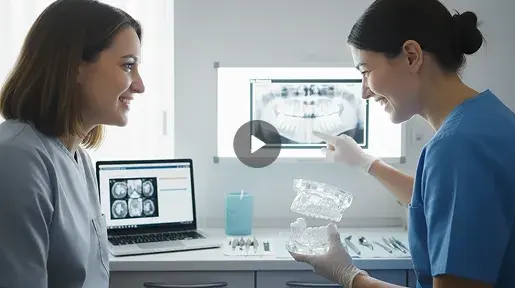
The patient attends the dental centre, where problems that can be corrected are identified. Diagnostic tests such as x-rays or intraoral scanner (a device that captures 3D digital images of teeth and gums) are carried out to obtain a comprehensive and personalised diagnosis.

2

Active phase: fitting of brackets

Begins with the fitting of the brackets and wire. Subsequently the wires will be changed according to the needs of the treatment and its progress.

3

Correction of the bite

The bite is corrected and the molars are fitted into the correct position, then proceeding to the levelling and alignment of the teeth.

4

Closing of dental spaces

After the movement of the teeth, the separation between them may be somewhat greater. This phase ends when the teeth are perfectly together.

5

Finishing and personalisation

The patient regularly attends the dentist to determine whether the teeth are now in the correct position. Small adjustments are made to perfect the dental position and ensure correct placement of the roots.

6

Removal of brackets and retention phase

This is the last phase of the treatment, and it occurs only when all previous objectives have been achieved. Once removed, it is important to use retainers to keep the teeth in their correct position.

Content supervised by our medical team

Henar Artiz Sanmartín

Graduated in Dentistry in 2003. Medical Director at Clínica Dental Adeslas since 2012.

Colegiado nº 28007122

Expert team

Meet our specialist implantologists

Fernando Reguera Sanz

Graduated in Dentistry in 2016. Leading orthodontist at Clínica Dental Adeslas.

Colegiado nº 28013537
Mª Ángeles Rodríguez Campo

Graduated in Dentistry in 2005. Expert in orthodontic treatments. At Clínica Dental Adeslas since 2011. 

Colegiado nº 28007842


Real cases

Reviews that support our expertise in dental implants

Iker

Tras los brackets, una operación y años de seguimiento, les estoy agradecido. Siempre pendientes de mí, profesionales y con un trato excelente.

Kim

Quedé muy contenta con el resultado de mi tratamiento de ortodoncia y con el trato de mi doctora. Lo recomiendo.

Paco

Desde el momento en que llegué, sentí una atmósfera amigable y acogedora. Los empleados fueron profesionales y alentadores en todo momento.

Any questions?

FAQs about brackets

Brackets can be metal, aesthetic (ceramic or sapphire), lingual (placed on the inner surface of the teeth) or self-ligating (with a clip system that reduces friction). Each offers specific solutions depending on aesthetic and treatment needs.

Brackets adhere to the teeth and, together with the metal wire, apply pressure to move them to their correct position. Brackets act as anchors for the wire, which generates the force needed to align the teeth.

Brackets correct problems such as crowded teeth, spaces between teeth (diastemas), crossbite, overbite and other bite problems (malocclusion).

Treatment duration varies per patient, but generally lasts between 18 and 36 months. It depends on the case and type of brackets used.

Brackets are effective for both children and adults. There is no age limit for orthodontic treatment.

It is important to maintain good oral hygiene by brushing teeth after every meal. It is also advisable to avoid hard or sticky foods that could damage the appliance.

It is common to experience some discomfort or pressure during the first few days after fitting or at regular adjustments. However, this discomfort is usually temporary and manageable.

It is advisable to consider brackets when there are dental alignment problems such as crowding, crossbite, overbite or any problem affecting the aesthetics or functionality of the mouth. An orthodontist can determine the best time following a personalised assessment.

Cost varies depending on the case and type of orthodontics applied. You can consult the Adeslas orthodontics price list or request a free review with one of our experts for a detailed quote.